Ed es director de marketing en GoJoe, donde ayuda a expandir el negocio a nivel mundial y colabora con los clientes para fomentar el compromiso interno. Anteriormente, Ed trabajó durante ocho años en el departamento de comunicación y marketing del equipo olímpico británico y en el departamento de marca y colaboraciones de la Universidad de Portsmouth.
Quick answer: Turnover rarely starts with a resignation letter. It starts with quiet disengagement, visible as falling participation and unused benefits months earlier. This blog covers what that gap really costs, how disengagement turns into exits, and how to reduce employee turnover with six practical steps. It also shows which early signals to track, how to measure return without inflated claims, what to look for in a retention platform, and how to protect employee privacy along the way. Read it as a working plan, not a theory piece.
Employee turnover is the rate at which workers leave an organization and must be replaced and reducing it starts not at the exit interview, but months earlier, when disengagement first shows up in behavior data.
U.S. employers recorded 3.1 million quits in August 2026, a rate of 1.9%, according to the Bureau of Labor Statistics, within 5.1 million total separations that month. Every one of those exits started earlier, usually as a quiet drop in effort, participation, and use of the benefits a company already pays for. That is why turnover and engagement belong in the same budget conversation. Finance sees the replacement bill, HR sees the empty chair, and few leaders see the months in between. This guide connects the two, shows what the gap costs, and lays out a plan HR can start this quarter.
What should you look for in an employee engagement and retention platform?
Puntos clave
• Disengagement shows up in behavior months before an employee resigns.
• Exit interviews and annual surveys arrive too late to change the outcome.
• Split every metric by manager, site, and shift before you report an average.
• Benefits that go unused are an early sign that someone is drifting.
• Set one trigger such as two falling cycles in a row and respond within 30 days.
What is the real cost of employee disengagement?
The cost of employee disengagement is the output lost while people have mentally checked out, plus the full price of replacing them once they leave. Most budgets only capture the second half. A realistic tally includes:
• Recruiting time: The cost of placing an advertisement, conducting the hiring process, and the period when the vacancy is unfilled.
• Onboarding and ramp-up: A new hire needs months to match the output of the person who left.
• Lost knowledge: Institutional knowledge, client relationships, and organizational context are all lost when employees leave.
• Manager time: Every exit pulls leaders away from the rest of the team.
• Team strain: Colleagues cover gaps, which can push the next person toward the exit.
Notice what is missing from most spreadsheets: the months before the resignation. The 2026 APA Work in America survey found that 51% of workers with low psychological capital planned to look for a new job within a year, compared with 19% of workers with high psychological capital. Intent to leave builds long before the notice period does.
How does disengagement turn into turnover?
It usually follows a pattern. First, effort and participation slip. Then people stop using the support their employer funds such as coaching, mental health services, and wellness programs. Next, small friction with a manager or workload goes unresolved. Finally, a recruiter message lands at the wrong moment and the decision is easy.
That pattern explains why employee engagement and retention deserve one shared system instead of two separate reports. Engagement is the leading indicator, and turnover is the lagging one. A team that stops joining anything, and stops using the benefits on offer, is telling you something that no exit interview will ever capture.
How to reduce employee turnover before people start looking
Work from the signal backward. These six steps turn how to reduce employee turnover into a monthly routine instead of a yearly project:
1. Measure behavior, not only opinion. Add participation reach and benefit use to your survey scores.
2. Segment everything. Report by manager, site, and shift so a strong average cannot hide one struggling team.
3. Fix the friction you find. Workload, manager fit, and unclear growth paths come up most often, so ask about them directly.
4. Route people to what you already fund. Many employees never find the benefits that would help them, and a clear path to those benefits costs less than a new hire.
5. Reward consistent effort. Recognition for steady healthy habits gives people a reason to stay involved.
6. Set a response trigger. When a team falls two cycles in a row, its leader proposes an action within 30 days.
Start with one team and three metrics, then expand once the routine works.
Which early signals show that someone is disengaging?
Look for patterns across a team instead of single events. Five signals deserve a place on your dashboard:
• Participation reach: The share of people joining company programs, including those who were inactive before.
• Benefit-use rate: How many employees use the support your company pays for.
• Activity streaks: Does program engagement last weeks or fade quickly.
• Absence patterns: Short, repeated absences concentrated in one group.
• Pulse sentiment: A five-question check on energy, workload, and manager support.
No single signal proves anything, but teams that know how to reduce employee turnover review these numbers every month. Together, they give HR a chance to talk with a manager while the relationship can still recover. Treating employee engagement and retention as one measurable system also gives finance something concrete to review each month.
Can you measure the return on retention work?
Yes, but be careful with the claims. Start by pricing the cost of employee disengagement for your own organization, using your recruiting spend, ramp-up time, and absence data, then compare it with the trend in your engagement signals over several quarters. Avoid crediting a single initiative with a dollar figure it cannot support.
Outside evidence helps too. GoJoe contributed to a 10% reduction in absenteeism costs at NatWest in 18 months. Absence is one of the clearest places where disengagement turns into a line item.
What should you look for in an employee engagement and retention platform?
Choose a platform that connects behavior, benefits, and rewards in one place, so HR does not stitch together four separate reports. Ask these questions in every demo:
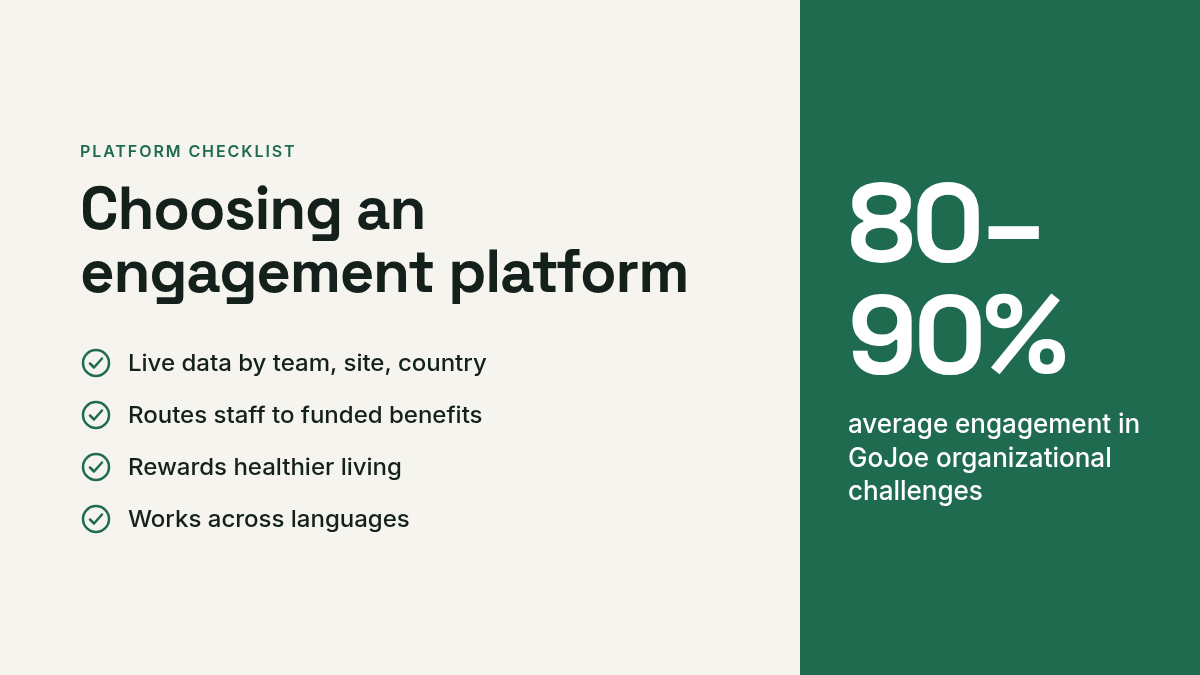
• Can it show participation and benefit use by team, site, and country?
• Does it update live instead of arriving as a quarterly export?
• Does it route each employee to benefits the company already funds? GoJoe's benefit navigation AI, Nightingale, developed with Stanford University researchers, does this automatically.
• Does it reward healthier living, so participation does not depend on who was already active?
• Can it support employees in different countries and languages?
Engagement is the proof point to request. GoJoe achieves 80–90% average engagement in organizational challenges, which shows what a platform people actually use looks like. See how corporate wellness programs fit into a retention plan, and ask every vendor to show how to reduce employee turnover with data, not slogans.
How do you protect employee privacy when you measure?
Employers see aggregated, anonymized data only. Each employee sees their own results and controls their privacy settings. GoJoe is ISO 27001 certified, GDPR compliant, and HIPAA-aligned.
Tell employees these rules in plain language before any measurement starts.
Conclusión
Learning how to reduce employee turnover starts with noticing disengagement early, and the cost of waiting grows every quarter. Build a short scorecard, split it by team, respond within 30 days, and give people a program they want to use.
Know More. Spend Smarter. Perform Better.
Retention is easier to protect when HR can see where people are pulling away and has something useful to offer them at that moment. GoJoe is the AI-powered health intelligence platform for global enterprise. It gives HR a live view of workforce health across every market, routes each employee to the benefit that fits through Nightingale, and rewards healthier living so participation lasts. Request a demo to see how it works.
Preguntas frecuentes
¿Qué es GoJoe?
GoJoe is the AI-powered health intelligence platform that helps global enterprises know their people better, get more from the benefits they already fund, and build a healthier workforce in every country they operate in. It is a corporate wellness platform that combines benefits navigation, wellness incentive and credit management, health risk assessments, rewards and team challenges in one system, used in 150+ countries.
How do you calculate the cost of employee disengagement?
Add lost output, recruiting, onboarding, and manager time for each exit, then include absence data from the months before it.
How quickly can you see results?
Participation and benefit-use trends usually shift within one or two cycles, while turnover takes several quarters to move.
Does higher pay fix turnover on its own?
Pay matters, but it rarely solves drift caused by manager fit, workload, or support that people never use.
How do wellness programs impact employee engagement and retention?
They give people a reason to take part, connect with teammates, and use benefits their employer already funds.
Which metric should HR watch first?
Start with participation reach by team, because a drop there often comes before a resignation.
am, because a drop there often comes before a resignation.